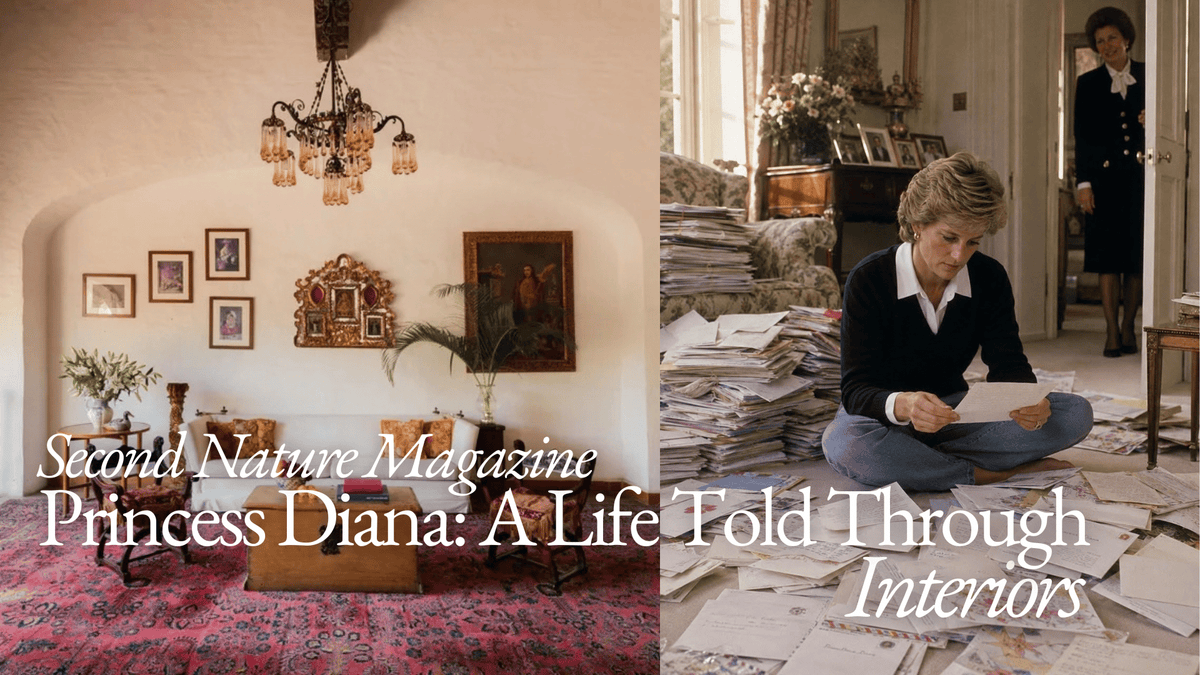
From the grandeur of Althorp to the chintz-filled rooms of Kensington Palace, the homes of Diana, Princess of Wales reveal a quieter portrait of one of the world’s most photographed women.
There are public figures whose lives become inseparable from the places they inhabited. For Diana, Princess of Wales, home was never simply a backdrop. Across country estates, palace apartments and one particularly famous London flat, her surroundings charted a remarkable transition—from aristocratic childhood to independence, royal life and, eventually, a search for something that felt more personal.
Despite the scale of the houses associated with her, Diana lived in surprisingly few places. What makes them compelling today is not simply their grandeur, but their contrast: centuries-old estates followed by a shared flat with friends; gilded royal rooms softened with chintz and family photographs; formal architecture made deliberately more comfortable.
Seen through the lens of interiors, they tell another version of Diana’s story—one composed of rooms rather than headlines.
Explore our Lady of the House: Kensington Collection →
Park House: The Beginning
Before the palaces, there was Park House.
Diana was born there in 1961 and spent much of her childhood in the house, which sits on the Sandringham Estate in Norfolk. Her mother, Frances Shand Kydd, had also been born there, giving the house a generational connection to the family.
Architecturally, Park House belonged to a world Diana would know intimately: the English country house and everything that came with it—large gardens, inherited furniture, traditional rooms and an atmosphere shaped as much by history as decoration.
Yet compared with the grand residences that would follow, Park House represents something more intimate: childhood before public life.
The house later took on an entirely different purpose. In 1983, Queen Elizabeth II gave it to Leonard Cheshire Disability, and it subsequently became a hotel designed to accommodate guests with disabilities.

Althorp: The Weight of History
If Park House represented childhood, Althorp represented inheritance.
The Spencer family's Northamptonshire estate has been its ancestral seat since 1508. Diana spent formative years there surrounded by the visual language of the English aristocratic interior: paintings, ceramics, antique furniture, imposing architecture and rooms accumulated rather than designed in a single moment. The collection at Althorp is particularly significant, encompassing centuries of furniture, portraiture and decorative art.
There is something distinctly contemporary about looking at these interiors now. Rooms assembled over generations rarely obey the rules of a single aesthetic. Objects coexist because of provenance, sentiment or simple longevity.
It is the antithesis of the perfectly coordinated interior.
And perhaps that is precisely why houses like Althorp remain so visually compelling. They are layered rather than styled.
Diana reportedly learned to tap dance in Wootton Hall, one of the estate's grand rooms. Today, Althorp is also her final resting place; she is buried on an island within the estate's lake.

Coleherne Court: A Room of Her Own
Then came London.
At 18, Diana moved into Flat 60 at Coleherne Court, a red-brick mansion block in Earl's Court, after her mother purchased the apartment for her. She shared it with three friends.
In architectural terms, it may be the least extraordinary of Diana's homes. In the story of her life, however, it is perhaps one of the most interesting.
For a brief period, Diana lived something approaching the life of an ordinary young Londoner. There were roommates, jobs, friends coming and going and the particular independence that accompanies having a front door of one's own.
It was also here that the outside world began arriving at that door.
During her courtship with Prince Charles, photographers increasingly gathered outside Coleherne Court. The domestic privacy represented by the apartment was gradually disappearing. Soon, Diana would leave the informality of a shared London flat for an entirely different category of home.

Clarence House: Entering the Royal Interior
Following her engagement to Prince Charles, Diana moved into Clarence House, where the Queen Mother was then living.
Designed by John Nash and completed in the 1820s, Clarence House belongs to Britain's great tradition of neoclassical royal architecture. Here, domestic life existed within a far more formal framework: important furniture, paintings, symmetry, ceremonial rooms and the accumulated visual vocabulary of the monarchy.
For Diana, the move also provided something increasingly difficult to find at Coleherne Court: protection from the press.
The transition feels almost cinematic. One moment, a young woman is sharing a London apartment with friends; the next, she is living behind the gates of a royal residence.
Her surroundings had become grander. Her world had also become considerably smaller.

Kensington Palace: Making a Palace Personal
It is at Kensington Palace that Diana's own relationship with interiors becomes particularly visible.
Following her marriage to Prince Charles in 1981, the couple moved into apartments within the palace. Diana worked with interior designer Dudley Poplak on their decoration, introducing a distinctly youthful interpretation of the English country-house aesthetic.
Looking back at photographs of the rooms today is an exercise in unapologetic 1980s decoration.
There was chintz. There were ruffles. Patterned upholstery met decorative borders, framed photographs, lamps and generously upholstered seating. Rather than attempting to make the palace aggressively contemporary, the interiors softened its formality.
They were elegant, certainly, but they were also comfortable.
That distinction matters.
Royal residences are inevitably filled with objects of historical significance, yet Diana's rooms suggest an instinct to make those objects coexist with ordinary domestic life. Sofas were meant to be sat on. Tables accumulated photographs. Pattern brought warmth to rooms whose architecture could otherwise feel imposing.
It is an approach that feels unexpectedly relevant today, as interiors move away from anonymous perfection and back toward personality, layering and rooms that reveal the people living inside them.
Diana remained at Kensington Palace following her divorce.
Selected by Surround: (Pictured Below)
- Victorian Carved Balloon-Back Chairs
- Brass and Glass Column Floor Lamp
- Bucolic Landscape Oil Painting
- Oriental Lacquered Coffee Table

Highgrove: The Country Counterpoint
Marriage also brought another house: Highgrove.
Set in the Gloucestershire countryside, Highgrove offered a pastoral counterpoint to Kensington Palace. Diana again worked with Dudley Poplak on the interiors; he later described the project as one of the most significant assignments of his career.
Yet a beautiful house does not necessarily become a beloved home.
Diana was reportedly less attached to Highgrove than Charles and preferred her London life at Kensington Palace. Nevertheless, the family regularly spent weekends there, and Princes William and Harry spent significant parts of their childhood at the estate.
The distinction is revealing. Architecture can provide beauty, history and status, but none of those things automatically produces a sense of belonging.
Pieces selected by Surround for the modern traditionalist: (Pictured Below)
- French Empire Revival Mahogany Dining Chairs
- Victorian Brass Six-Light Chandelier
- Rococo-Style Porcelain Centrepiece
- Antique French Floral Henri II Walnut Dresser
- Deep Emerald Chest Louis XV French Commode
- Vintage Bohemian Crystal Empire Chandelier

The Rooms Behind the Icon
Perhaps this is what makes Diana's homes so fascinating decades later.
They contain nearly every archetype of the British interior: the ancestral country estate, the red-brick London apartment, the neoclassical royal residence, the palace and the romantic country house.
But together, they also demonstrate something much simpler.
A house and a home are not necessarily the same thing.
The grandest rooms in Diana's life were often those governed by the greatest traditions and expectations. The spaces that appear most personal were the ones in which formality could be loosened—a shared apartment, a comfortable sofa, family photographs on a table, chintz where there might otherwise have been ceremony.
Her interiors were never radical in the conventional design sense. Instead, their appeal came from softness: an instinct to make imposing surroundings feel lived in.
And perhaps that is the enduring lesson of Diana's interiors. The most memorable rooms aren't always the most perfectly designed. They are the ones that reveal something about the person who occupied them.
For all the palaces, estates and priceless objects, home remained something altogether more human.