After years of restrained palettes, sensible furniture and impeccably coordinated rooms, design is beginning to dream again. From sculptural seating to distorted mirrors, Surrealism is finding its way back into the home.
For some time, the ideal interior seemed to be one that behaved itself. Walls were quiet, furniture was softly rounded and every object appeared to exist within the same carefully controlled palette. Rooms became serene, tasteful and increasingly difficult to remember.
Now, something stranger is taking hold. Chairs resemble body parts, mirrors melt at the edges and lamps appear to grow from the floor like improbable flowers. Familiar objects are being stretched, distorted and reimagined just enough to make us look twice.
Surrealism, with its appetite for the irrational and unexpected, is returning to our interiors. But this is less about recreating the past than recovering a certain creative freedom: the freedom to make a room feel curious, emotional and slightly impossible.
When the Familiar Becomes Strange
Surrealism emerged in Europe during the 1920s, as artists and writers turned towards dreams, the unconscious and the irrational. Everyday objects became particularly compelling. Alter their scale, material or context and something familiar could suddenly feel humorous, seductive or unsettling.
Furniture offered the perfect canvas. Salvador Dalí and Edward James's famous Mae West Lips Sofa, conceived in the 1930s, transformed a functional object into a body part, a sculpture and a joke at once. It did not quietly complete a room; it changed the atmosphere around it.
That same impulse is resurfacing today.

The End of the Perfect Interior
The renewed interest in Surrealism arrives after years dominated by restraint. Neutral tones, pale woods and carefully edited rooms offered visual calm but, at their most repetitive, began to resemble one another.
Digital platforms accelerated this sameness. A successful interior could be saved, shared and reproduced thousands of times, while algorithms repeatedly presented us with variations of what we already liked. Inspiration became abundant, but surprise became harder to find.
Surrealist design interrupts this cycle. A cloud-shaped seat, an eye-like mirror or a table balanced on sculpted feet may not be the most logical choice in a room, but logic is precisely what Surrealism was created to challenge.
After years of asking whether an object is timeless, versatile or easy to style, perhaps we are ready to ask a more interesting question: does it make us feel something?
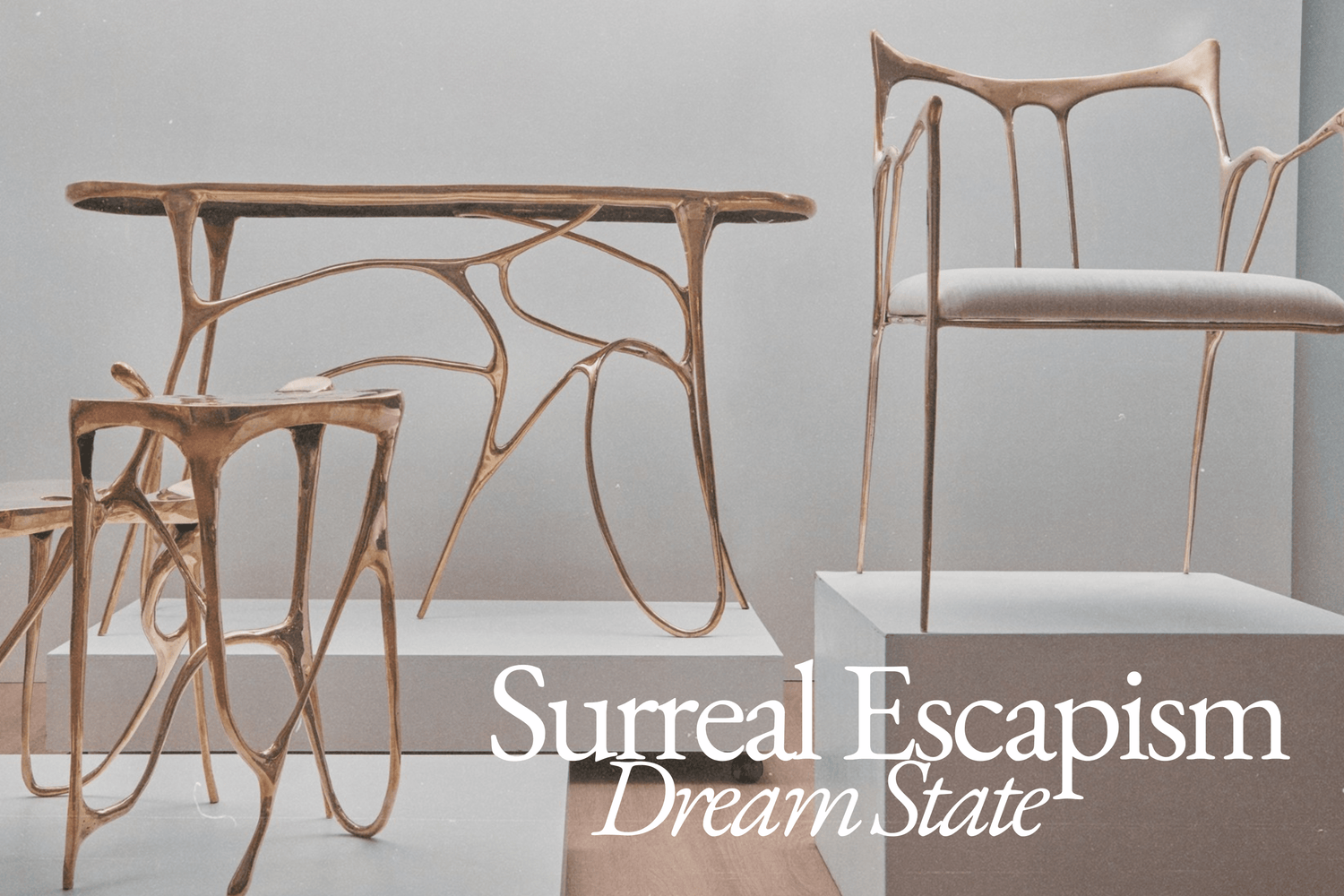
Some of our favourite surrealist design sculpture’s include: (Pictured below)

Furniture With a Subconscious
Surrealist furniture often begins with something recognizable and then quietly disrupts it. A cabinet appears to bend, a lamp resembles an organism or a chair seems entirely functional until its proportions suggest otherwise.
This tension between function and fantasy is central to its appeal. Traditional furniture design often attempts to solve a problem as elegantly as possible. Surrealist design complicates the problem deliberately, allowing ambiguity to become part of the object's purpose.
A table can still hold a glass while appearing to crawl across the floor. A mirror can reflect the room while distorting its architecture. These pieces do not abandon function; they simply refuse to let function have the final word.
Surround Picks: (Pictured below)

Why Fantasy Feels Necessary Now
Every decorative movement reflects something about the world outside the home. Today's attraction to fantasy, theatricality and visual humour may partly be a response to digital fatigue and the increasingly blurred boundary between reality and simulation.
When so much of life is filtered through screens, the home offers a place where imagination can become physical. An eccentric chair has weight and texture. A strangely proportioned object asks to be walked around and experienced from different angles.
Surrealism allows the home to become a private landscape where ordinary rules can briefly be suspended. Reality, after all, is already waiting outside the door. Our interiors do not always need to reproduce it.
Some of our favorite Surround pieces include: (Pictured Below)
- Sacred Ganesha and the Silver Mushika
- Burmese Sitting Monk (Eroded Temple Figure)
- Industrial Folk Art Dog Sculpture on Wheels

The Art of the Unexpected Object
A surrealist interior does not require every surface to perform a visual trick. Often, a single unexpected object is enough.
Against a quiet wall, an unusually shaped mirror becomes almost architectural. In a restrained living room, a sculptural chair can alter the entire composition. A lamp with an exaggerated form may introduce just enough strangeness to make familiar furniture feel newly considered.
The contrast is important. When everything is extraordinary, very little feels surprising. Surrealist pieces are most powerful beside objects that are simple, aged or recognisably domestic.
The intention is not randomness. It is controlled disorientation.
That spirit of imaginative disruption is alive in a new generation of designers and makers, even when their work sits outside Surrealism in the strict historical sense. Jesper Kirketerp plays with sculptural form and the unexpected, while Tenderly Studio and Oh!dinary find intrigue in objects that feel familiar yet somehow shifted from the everyday. Elsewhere, the work of Masaya and Lotus Arts de Vivre draws from the natural world, transforming organic references, unusual materials and meticulous craftsmanship into pieces that border on the fantastical. Seen together, their work speaks to a broader desire for objects that do more than simply serve a purpose; pieces with enough presence, curiosity and imagination to briefly alter our perception of the room around them.
This month, we’re featuring Jesper Kirketerp’s ‘Four Old Men Looking Up Kintsugi’ (Pictured Below)

A Home Should Contain a Few Mysteries
The appeal of Surrealism lies partly in its refusal to explain everything. It leaves room for interpretation, curiosity and private associations.
This ambiguity is precisely what formulaic interiors tend to remove. When every object matches and every corner has been perfectly resolved, there is little left for the imagination to complete.
Surrealism gives some of that mystery back. It reminds us that a home is not a showroom and beauty does not always need to be sensible. Furniture can be useful and peculiar; rooms can be elegant and humorous. An object can belong without matching anything around it.

Reality Is Overrated
Surrealism is returning because our interiors have become fluent in the language of good taste. We know which colours create calm, which silhouettes photograph well and which materials suggest understated luxury. The results may be beautiful, but beauty without surprise can become strangely anonymous.
The surrealist object offers another possibility. Not every chair needs to disappear quietly into a room. Not every lamp needs to behave like a lamp, and not every object needs to justify its existence through usefulness alone.
Sometimes the piece that should not work is the one that gives the room its identity.
At Surround Living, we believe the most compelling homes are shaped by curiosity rather than convention. Explore our collection of sculptural furniture, vintage discoveries and unexpected objects, chosen for their ability to transform not only the way a room looks, but the way it feels.
Because a well-designed home should offer comfort, beauty and, every now and then, a reason to question reality.
Shop our Surreal Escapism collection Here.