


In Loving Memory of King Bhumibol Adulyadej The Great, Surround looks north to Chiang Mai—where land, livelihood and generations of craftsmanship continue to shape Thai design today.
There is a particular kind of beauty that belongs to Northern Thailand. It is found in the grain of old wood, the irregular rhythm of handwoven cloth, the deep indigo of naturally dyed cotton, and objects whose makers leave just enough evidence of the hand behind.
In Chiang Mai, craft has never existed simply for decoration. It is intertwined with agriculture, geography and daily life. Cotton is grown before it is spun. Plants become dyes. Bamboo becomes structure. Timber becomes furniture. A textile carries not only a pattern, but traces of the community that produced it.
This relationship between land, livelihood and making also sits at the heart of one of the most significant chapters in modern Thai history: the Royal Project initiated by His Majesty King Bhumibol Adulyadej the Great.
As Thailand commemorates King Rama IX, Surround looks north—not simply to revisit the past, but to consider how its principles continue to live through the materials, makers and objects of contemporary Thai design.

It Began With the Land
The story begins in the mountains.
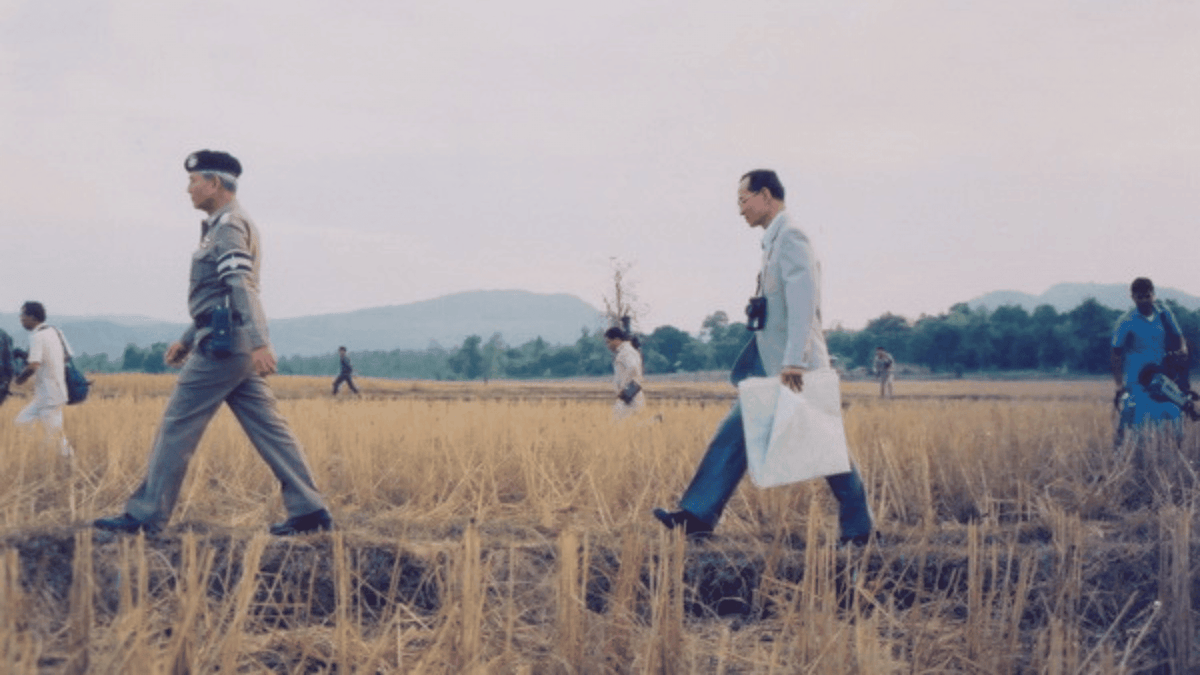
King Bhumibol established the Royal Project in 1969 with the aim of improving the livelihoods of highland communities, replacing opium cultivation with viable crops and protecting the forests and watersheds on which those communities depended. What followed developed into a far-reaching model combining agricultural research, environmental conservation and economic self-reliance.
Chiang Mai became central to that story.
Rather than viewing the northern landscape as something to be overcome, the Royal Project began with an understanding of the land itself: its climate, altitude, communities and possibilities.
There is a remarkably contemporary idea embedded within this philosophy. Progress did not have to mean erasing what was already there. It could begin by understanding it.

From Cultivation to Craft
Agriculture is at the heart of the Royal Project, but Northern Thailand's material culture reveals how closely the cultivation of land and the making of objects have historically existed alongside one another.
In rural communities, making could be part of the rhythm of everyday life. Fibres became cloth. Bamboo became baskets. Wood became stools, vessels and architecture. Skills travelled through families and villages, often from one generation to another.
Alongside King Bhumibol's agricultural initiatives, the royal family's support for rural craftsmanship—most notably Queen Sirikit The Queen Mother's championing of Thai textiles—helped bring renewed attention to regional weaving and craft traditions.
What might once have been considered simply a household skill increasingly became recognised as cultural knowledge worth protecting.
And nowhere is that continuity more visible than in the loom.

The Northern Hand
Look closely at a handwoven textile and perfection is not really the point.
Threads shift. Colours fluctuate. Patterns carry tiny variations. What industrial production might classify as inconsistencies are precisely what give the material its presence.
In the highlands of Chiang Mai, that knowledge remains alive. Karen mothers and retired weavers continue to produce thick-yarn cushions and runners using the traditional backstrap loom—a deceptively simple device in which the weaver's own body becomes part of the tension and structure of the cloth. Pieces made through this tradition are represented on Surround today.
A woven object becomes a record of technique, time and place. When it enters a contemporary home, that history comes with it.
This is where Paya offers another chapter in the story.
The brand's beginnings can be traced to an encounter with traditional handwoven cotton in Chiang Mai. What began with just three rolls of fabric eventually developed into a wider language of home textiles and furniture, while its network of skilled weavers and woodworkers remained in Chiang Mai. Paya continues to work with handweaving rather than factory production; according to the brand's story on Surround, a single roll of its fabric can take as long as three months to complete.
Today, Surround's Paya selection ranges from handwoven Mudmee cotton and ikat cushions to Lisu embroidery, silk and carved wood pieces.
Some notable Northern textiles: (Pictured Below)
- Triangular Cushion "Pakhao ma" Thai Pattern ผ้าขาวม้า
- Baby Blue IKAT Pastel Stripe Handwoven Triangle Cushion
- Decorative Table Runner / Wall Tapestry
- Handwoven Waist Loom Weave Cushion

Tradition Is Not a Style
Perhaps one of the most interesting lessons of Northern craft is that tradition does not have to mean preservation under glass.
A weaving technique can survive while its colours change. An old material can take on an unfamiliar silhouette. A carved wooden stool can move from a vernacular setting into a contemporary Bangkok apartment and suddenly be read as sculpture.
The knowledge remains; the expression evolves.
It is a philosophy visible in the work of Naphakard, a contemporary creative studio based in Chiang Mai and founded by Ratthee Phaisanchotsiri. Its work occupies the space between art, furniture and craft: meditation stools, ceramic vessels, aluminium forms and lighting reduced to quiet, tactile silhouettes.
A natural hemp table lamp by the studio, for instance, is made in Chiang Mai using hemp fabric wrapped across its softly geometric form. There is little overtly "traditional" about the finished object, yet its emphasis on natural material, tactility, restraint and the relationship between object and environment feels unmistakably connected to the North.
Explore our favorites: (Pictured Below)

From Lanna to the Contemporary Interior
The influence of the North can be equally subtle in furniture.
Materials associated with everyday Thai life—rattan, woven fibre, wood, cotton and basketry—have repeatedly been reinterpreted by Thai designers rather than abandoned in favour of industrial materials.
Our collection of Yothaka, for instance, offers another perspective on this evolution, with pieces ranging from natural-rattan seating to woven and macramé furniture currently represented in the marketplace.
Rather than seeing craft and contemporary design as opposites, these objects suggest that the two can occupy the same room.
And perhaps this is why Northern Thai design feels particularly relevant now.
After decades of interiors defined by immaculate surfaces and anonymous mass production, we find ourselves drawn again to things that reveal where they came from: timber with visible grain, irregular ceramics, woven fibres, patinated metals and textiles where the movement of the loom remains visible.
Notable mentions, curated by Surround: (Pictured Below)

Land, Life & Craft
Explore The Northern Legacy: Crafted in Chiang Mai, a Surround Living collection celebrating the materials, makers and enduring creative language of Thailand's North
More than half a century after the Royal Project began, its story offers an unexpectedly relevant lens through which to consider design.
King Bhumibol's work in the North was fundamentally concerned with relationships: between people and land, agriculture and livelihood, forests and communities, knowledge and independence. The Royal Project describes its original mission as improving living conditions among highland communities while replacing opium cultivation and rehabilitating natural resources.
Craft follows a surprisingly similar chain. A wooden object begins with a tree. A textile begins with a fibre. A natural dye begins with a plant.
And before any of them become something we place in our homes, there is knowledge: how to grow, harvest, dry, spin, weave, carve, join and finish.
Today, Chiang Mai is simultaneously ancient and experimental. Traditional looms continue to operate while young studios produce contemporary furniture and objects only kilometres away. One does not cancel out the other. The two exist in conversation. And in the best examples of Thai design, it can be difficult to tell exactly where tradition ends and contemporary design begins.
Legacy is not something that remains unchanged.
The land provides the material.
The hand gives it form.
Each generation makes it its own.


